[CAPF] Inclusive Governance for Climate Resilience in the Mekong Delta – Insights from the CoRe Project
![[CAPF] Inclusive Governance for Climate Resilience in the Mekong Delta – Insights from the CoRe Project](https://mindthegap.vn/wp-content/uploads/2025/07/480874746_638919575385113_3326367000972558603_n.jpg)
By Phan Ky Trung, Van Pham Dang Tri, and Mai Thu Ha
In a previous blog a few years ago, we had a dialogue with Phan Ky Trung – Chevening Scholar 2019/2020 about the CoRe project after finishing his MSc in Water Resources Management at the University of Southampton, UK. Below is the result of the project and the policy brief to address climate change in the region.
The Chevening Alumni Programme Fund (CAPF) is our way of supporting you to grow the Chevening alumni community into the most engaged, active, and impactful international scholarship alumni network in the world. The CAPF provides funding for Chevening alumni with realistic and achievable ideas to enhance Chevening’s impact around the world.
Empowering Local Climate Action through Global Support
This blog post draws on findings from the CoRe (Community Resilience) project, a multi-year initiative funded by the UK Foreign, Commonwealth & Development Office (FCDO) through the Chevening Alumni Programme Fund (CAPF). With support spanning from 2021 to 2025, CAPF has enabled in-depth research, stakeholder engagement, and policy dialogue aimed at strengthening climate resilience in Vietnam’s Mekong Delta.
The project is managed in-country by the British Embassy Hanoi and led by the Research Institute for Climate Change (DRAGON-Mekong) at Can Tho University. This collaboration exemplifies how international cooperation can empower local communities to address the urgent challenges of climate change through inclusive, evidence-based governance.

Understanding the Challenge
The Mekong Delta is on the frontlines of climate change. Rising sea levels, saltwater intrusion, and extreme weather events are threatening the livelihoods, health, and well-being of millions. But these impacts are not felt equally. Vulnerability is shaped by a complex web of social, economic, and environmental factors.
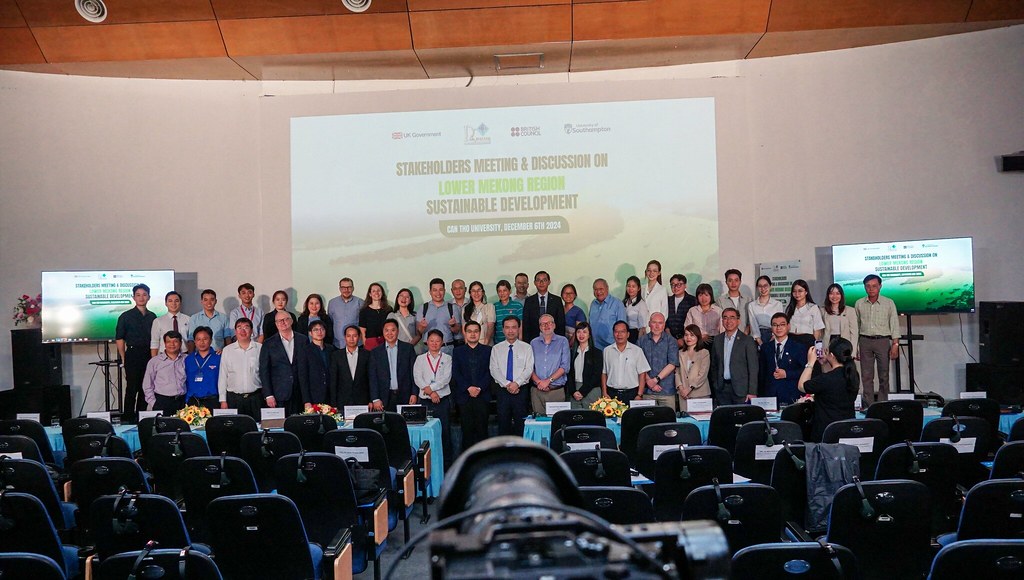
The CoRe (Community Resilience) project, led by the Research Institute for Climate Change (DRAGON-Mekong) at Can Tho University and supported by the British Embassy Hanoi, explores how inclusive governance can strengthen climate adaptation in the Lower Mekong Region. Through household surveys, participatory rural appraisals, and spatial vulnerability mapping, the project offers a data-driven, community-centered roadmap for resilience.

Key Findings from the Field
- High Social Vulnerability: 40% of surveyed households are highly vulnerable. Ethnic minorities and remote communities face the greatest risks due to poor infrastructure, water insecurity, and limited livelihood options.
- Climate-Sensitive Livelihoods: Most households rely on agriculture—particularly rice, orchard, and shrimp farming—which is increasingly disrupted by saline intrusion, drought, and extreme weather.
- Inequality in Adaptation Capacity: Households with many dependents and limited education or language skills struggle to access clean water, healthcare, and climate-related information.
- Spatial Disparities: Vulnerability varies by location, with low-lying and riverine areas like Cu Lao Dung facing the highest risks.
- Community Awareness and Action: While 72% of households are aware of climate risks and have taken adaptive measures, 28%—mostly marginalized groups—lack access to critical information and technologies.
Policy Recommendations for Inclusive Adaptation
1. Localised and Inclusive Adaptation Planning
- Tailor policies to local vulnerabilities using spatial data.
- Prioritize ethnic minorities and remote communities in development plans.
2. Infrastructure Investment for Resilience
- Expand access to clean water and improve saline intrusion barriers.
- Upgrade irrigation systems and develop resilient water infrastructure.
3. Promote Livelihood Diversification
- Support climate-resilient farming models like shrimp-rice rotations.
- Provide technical and financial support for alternative livelihoods.
4. Capacity Building and Information Access
- Implement education and training programs for vulnerable groups.
- Improve access to local-language media and digital tools for climate awareness.
5. Strengthen Policy Integration and Participation
- Embed Social Vulnerability Index (SVI) assessments in policymaking.
- Facilitate inclusive participation, especially from women, youth, and ethnic groups.
6. Leverage International Cooperation
- Secure global partnerships for funding, technology transfer, and best practices.
- Engage in cross-border initiatives for sustainable delta-wide adaptation.

Thematic Insights from Stakeholder Dialogues
Sustainable Livelihoods
- Strengthen social capital, expand healthcare (including mental health), and ensure long-term sustainability of community projects.
Gender-Responsive Adaptation
- Promote climate literacy, empower youth, institutionalize gender equity, and adopt ecocentric policy perspectives.
Water Security
- Modernize infrastructure, promote climate-resilient agriculture, and restore ecological systems through integrated water management.
Just Energy Transition
- Invest in renewable energy, support smallholder participation in carbon markets, and foster youth-led innovation in sustainability.
Conclusion: A Call for Inclusive Climate Governance
To reduce climate vulnerability in the Mekong Delta, policymakers must adopt data-driven, inclusive, and locally grounded approaches. This means integrating local knowledge with scientific research, ensuring equitable participation, and investing in the resilience of the most affected communities.
Inclusive governance is not just a principle, it’s a pathway to sustainable, just, and effective climate adaptation.
Credits and Acknowledgements
This policy brief was developed under the CoRe project, funded by the UK Foreign, Commonwealth & Development Office (FCDO) through the Chevening Alumni Programme Fund (CAPF) in 2021/2022, 2022/2023, and 2024/2025. The project is managed in Vietnam by the British Embassy Hanoi and led by the Research Institute for Climate Change (DRAGON-Mekong), Can Tho University.
Learn more about CAPF: https://www.chevening.org/resource-hub/alumni/programme-fund/
Follow CoRe: https://www.facebook.com/TheCoReVietnamOfficial